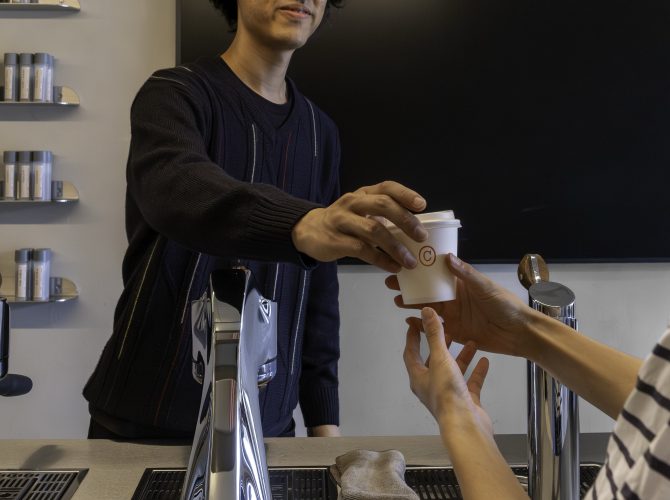
It’s been more than twenty years since Mecca Coffee first opened its doors in Sydney, with their newest addition on Foley Street bringing together decades of experience, enduring relationships and the curiosity that has driven the business from the beginning. For Mecca Coffee founder Paul Geshos, alongside Stacy Masiruw, his life & business partner, Foley Street represents a new chapter, but not necessarily a louder one.
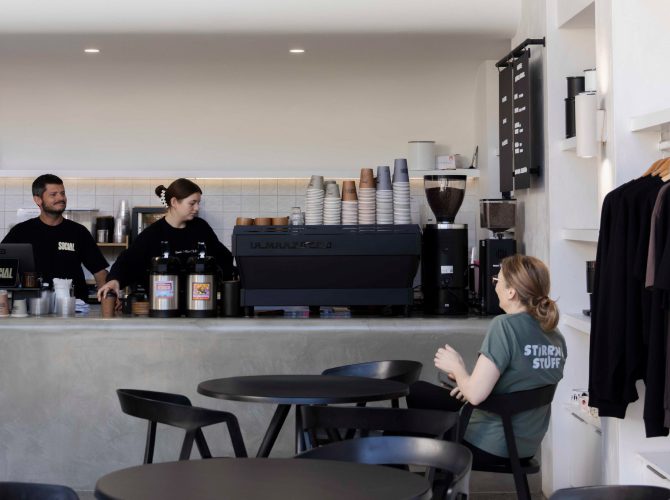
More than three years in the making, designed alongside Matt Woods, the Darlinghurst venue is intentionally small and intimate. It portrays a quiet confidence and understanding of what matters most.
“After twenty plus years we didn’t need to make noise with this one, we wanted a space that felt warm, considered and a little hidden away, in one of Sydney’s most character filled neighbourhoods,” Paul says. “When people walk through the door we want them to feel like they’ve found something, not been sold something.”


That sense of discovery has been at the heart of Mecca Coffee from the beginning. When Paul entered Sydney’s specialty coffee landscape more than two decades ago, conversations about origin, processing and varietal were far from commonplace. Today, Paul witnesses those conversations happen naturally across the bar.
He’s noticed that customers are more curious, informed and invested in good coffee, not only in how it tastes, but where it comes from, who is behind it and the journey it has taken to reach their cup. Education has played an important role in that shift, building a deeper appreciation for quality, provenance and more ethical, transparent supply chains.
As the industry has matured, so too has the conversation, opening up new possibilities for what coffee can be and the connections it creates. Paul believes that growing interest has been one of the most significant changes he’s witnessed.
“What’s changed is the level of curiosity. Twenty years ago, you were introducing people to the idea that coffee had an origin at all, now customers ask about processing methods and varietals without blinking. Cold coffee went from a summer novelty to a year-round category,” he says.

But amid that change, the principle underpinning Mecca Coffee has remained the same. Paul adds; “What hasn’t moved is the reason we started, the relationship with the person who grew the coffee. That’s still the first decision in everything we do, before roast profile, before menu, before a single design choice on a new space like Foley Street.”
Producer relationships remain the foundation of Mecca Coffee’s approach. In recent years, Paul and Stacy have also returned the business to retail with renewed intent, considering not only what is served in the cup, but the hospitality, design and sense of place that surrounds it.
“The producer relationships have always been the bedrock our business is built on,” Paul says. “Over these past two years we’ve returned to retail with real intent, honest hospitality sits at the heart of it, and beautiful spaces alongside a genuine place in the community are woven in right alongside the coffee. It’s truly the sum of all of these that we’re investing in and excited about.”


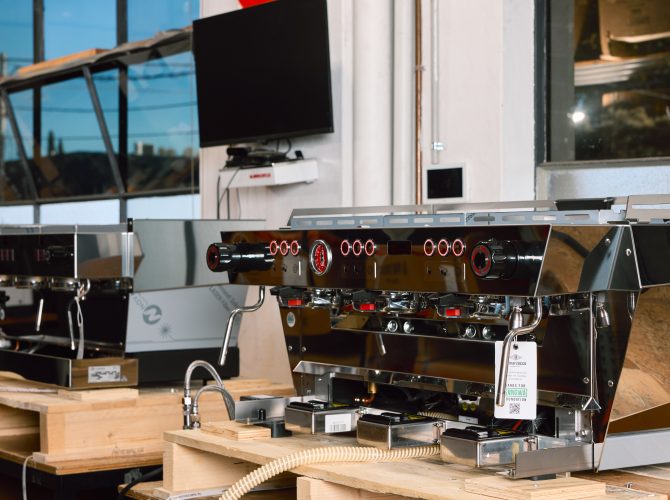
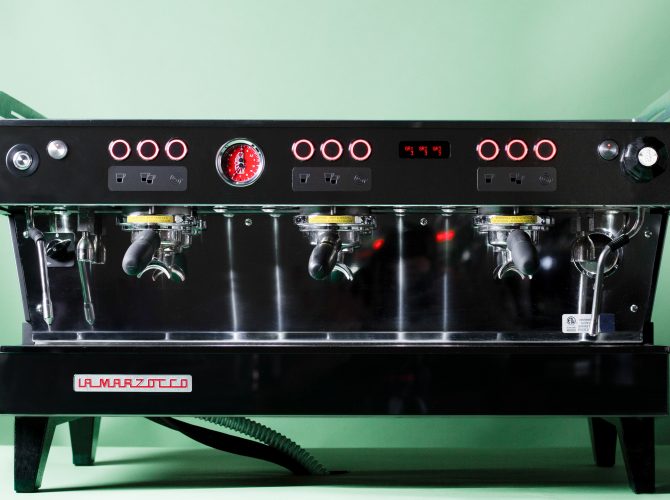
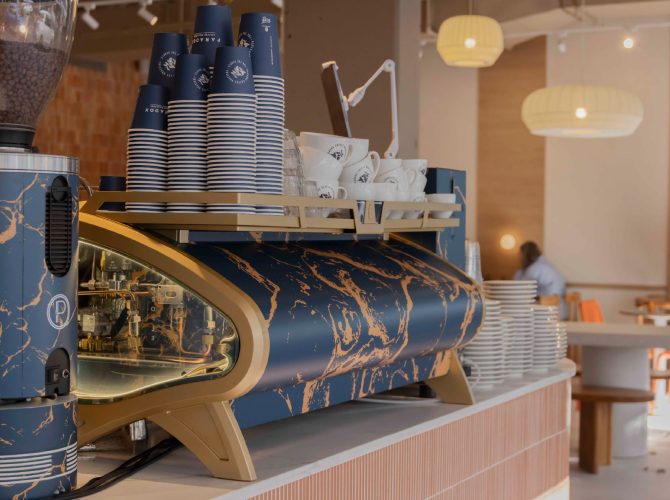
Foley Street is perhaps the clearest expression yet of those ideas brought to life. Every element of the space has been considered as part of one cohesive experience; from the way customers move through it, to the equipment behind the bar. At its centre is a La Marzocco Strada X, working alongside Swan and Jay grinders. For Mecca Coffee, the equipment was approached as a complete workflow rather than a collection of individual pieces, with each playing a different role in supporting the coffee and the people preparing it. The Strada X gives Paul and the Mecca Coffee team greater freedom to explore extraction and the nuances within each coffee. As roasters, that ability to keep asking questions of flavour is important.
“The Strada X gives us ultimate expression in extraction, it lets us explore nuance in the coffee that isn’t available to us with a conventional pump machine,” Paul says. “As roasters we’re curious about the exploration of flavour, and this combination lets us go deeper into that.”
Alongside it, the Swan brings precision and consistency to the workflow at volume. Mecca Coffee has found its grind adjustments intuitive and dosing reliable, with cleaner, more defined extractions in the cup, particularly through busy periods.
“For us, the Swan has proven to be a thoughtful balance of precision, workflow, and design,” Paul says. “In a busy cafe environment, it handles volume with consistency and clarity, which means our baristas can spend less time managing the grinder and more time engaging with customers.”
That balance between quality and speed carries through the entire Foley Street setup.

For Mecca Coffee, the ideal workflow is one where the team can grind and brew with 0.1g accuracy without sacrificing pace, maintaining the same level of detail regardless of how busy the bar becomes. And while coffee equipment has become considerably more sophisticated over the past two decades, Paul doesn’t see technology as removing craft from the role of the barista. If anything, he believes it can return more of it.
Twenty years ago, much of a barista’s skill came from learning how to manage inconsistent equipment. Today, when the equipment can reliably take care of more of those variables, the person behind it has greater capacity to concentrate on taste, judgement, hospitality and the coffee in front of them.
“Now the machine holds its end of the bargain, which means what separates a good cup from a great one is entirely down to the person brewing it, their palate and their read on the coffee that day,” Paul says.
“Dialling in the coffee every day is an art form. Precision returns us back the craft, it doesn’t replace it.”


Far from all the new technology behind the bar at Foley Street, the relationship between Mecca Coffee and La Marzocco began with a considerably simpler setup.
In 2000, Paul bought his first La Marzocco Linea Classic. Not long after came visits from Guido Bernadinelli, Lorenzo Carboni and Roberto Bianchi from the La Marzocco factory in Florence, hosted by Paul at his first café. What started around coffee machines became a relationship that would continue as both Mecca Coffee and La Marzocco evolved.
“We’ve remained good friends since, and that continues to this day,” Paul says. Some of Paul’s fondest memories take place in Florence, where he spent time with Piero Bambi working through the development of a Mistral espresso machine prototype.
It was a very different era of coffee equipment development. Paul remembers troubleshooting the machine alongside the factory team, repeatedly referring to schematics recorded on a piece of cardboard.
“We were a little coffee bar in the city working with the factory through that whole development, it was a magical time for us collaborating together.” More than two decades later, a Strada X, Swan and Jay now sit together at Foley Street. The technology has moved forward significantly, as have the businesses on either side of the relationship.
Many of the relationships have moved forward with them, one of those belongs to La Marzocco Australia Technical Specialist Damien Moore, affectionately known as ‘Damo’. Damo and Paul first worked together more than 23 years ago, when, as Paul puts it, they were both “finding our feet in this industry”. They’ve remained great mates ever since. Today, Damo is one of Mecca Coffee’s closest sources of technical support at La Marzocco Australia. But after more than two decades, the relationship is difficult to describe purely in terms of machines, service and support. There is a shared history there: careers taking shape, businesses growing, life happening and an industry changing around them.


“He’s now our biggest support and advocate at La Marzocco, and that relationship is a big part of why the brand has felt less like a supplier and more like family over the years,” Paul says.
“With that level of care and commitment from his end, we feel genuinely supported, both locally through Damo and from the factory in Italy.”
From Paul’s first Linea Classic and personalised Mistral prototype development in Florence to the Strada X, Swan and Jay today, the machines tell part of the story. The relationships that have grown around them tell another.
For Paul and Stacy, Foley Street is also an opportunity to bring the different parts of Mecca Coffee closer together. Its retail stores provide a direct connection between the purchasing program, the producers behind each coffee and the person ultimately drinking it.
“Our retail stores let us work more in sync with our purchasing program,” Paul says. “Our goal is to bridge the producer with the customer, and Foley Street is the culmination of over twenty years of that work. This latest iteration forms the foundation for where we’re headed into the future.”

Foley Street captures where Mecca Coffee finds itself after more than two decades: still asking questions, still investing in the details and still surrounded by many of the people who have been part of the journey. The equipment has evolved, the coffee industry has evolved, and Mecca Coffee has evolved with it.
Congratulations to Paul, Stacy and the entire Mecca Coffee team on Foley Street. After more than twenty years of coffee, collaboration and friendship, it’s a privilege to still be on the bar with you, and we can’t wait to see where this next chapter leads.
Visit Mecca Coffee Foley Street.
Shop 11/90 Oxford Street (Enter via Foley Street)
Darlinghurst NSW 2010
@meccacoffee